
Frequent readers of this weblog may have started to wonder whether the activities of the Biomedical Electronics Group have gradually fainted and dissolved in eternity, its members have all become hobos and it all ended in a big dream. Bzinga. The truth is, of course, that everybody is very busy and under the yoke of some deadline or another.
 Senad and June been working very hard on a first proof-of-principle of a Tinnitus detector circuit. Such a circuit should allow for detection of the spatial properties of tinnitus and give objective information on its severity. This could, in turn, lead to more refined or adjusted stimulation therapies. Don’t sell your mother for it, yet, but expectations are high. The findings will be worked out in a manuscript, to be submitted to the annual BioCAS Conference today.
On the detection side of things, Yongjia has been working very hard on the new type of level-crossing analog-to-digital converter, described in an earlier weblog. Also this work will be submitted to the BioCAS Conference.
Duan Zhao received the good news that our paper (together with the Holst Centre) on a reconfigurable subsampling receiver has been accepted for presentation and publication at the PIMRC Conference in Toronto. Congratulations. He just returned from a visit to his home country and we’re happy to have him back again.
Of course there is more that can be reported, such as the coming ELCA day trip, the preparations for organizing BioCAS 2013 in Delft, the IMDI NeuroControl, more power-efficient neurostimulation circuits, higher-efficiency RF energy harvesting circuits, June’s paper that got accepted in Transactions on Circuits and Systems-I: Regular Papers (congrats, too), Sandro’s and Senad’s paper that enjoyed the same fate (congrats, too), STW Perspectief and how the Dutch Ministries of Economical Affairs, Agriculture and Innovation and of Health, Wellbeing and Sport have no clue on how to increase valorization in the Netherlands (as witnessed yesterday at the MedTech West Event), but this would make good stuff for another blog. So stay tuned!
Wouter
 Last Tuesday I saw an excerpt of an interesting episode on Dutch television about what happens with the human brain when it ages and in particular what happens with it in the unfortunate situation of Alzheimer’s disease. This episode, presented by the well-known and charming Dutch news presenter
  With this promising statement of
 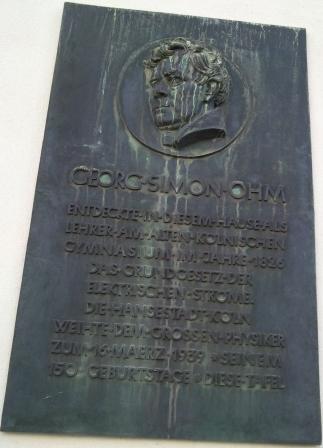 Last week, I was in Köln, Koeln, Keulen or Cologne (depending on from which country you are) with my family and while on our way to the Dom, Cologne’s well-known cathedral, I bumped into one of the greatest heroes of electric circuit theory: Georg Simon Ohm. The sign says that "George Simon Ohm discovered, in this house, being a teacher at the Old Gymnasium in Cologne, in 1826, the foundation of electric current."
  "Musical activity throughout life may serve as a challenging cognitive exercise, making your brain fitter and more capable of accommodating the challenges of aging," study researcher Brenda Hanna-Pladdy, a neurologist at the Emory University School of Medicine, said in a statement. "Since studying an instrument requires years of practice and learning, it may create alternate connections in the brain that could compensate for cognitive declines as we get older."
 In future implants might be recharged by the brain. (Photo: Ana Laura Santos)
 Since the algorithm for computing the impact factor is simple, it is also simple to manipulate. And this is exactly what is being done constantly, by authors, who for this reason include a lot of self-citations in their manuscripts, and by journals that impose a lot of self-citations (to the journal) on their authors. Since this is seriously blurring the reputation of people and journals, but also the minds of our evaluators, more objective figures-of-merit have been discussed, the most elegant one probably being the Article Influence. If you are interested you may wish to (and if you are a boss of a scholar or a scholar yourself, you probably should) check out
  Still in shock by the post below? Don’t be. As always there’s hope on the horizon. The slides of the Hermes Partnership Workshop "Visions Towards ICT Supported Health" of last week have been posted online. If you want to find out more about one or more of the topics below, don’t hesitate to click